

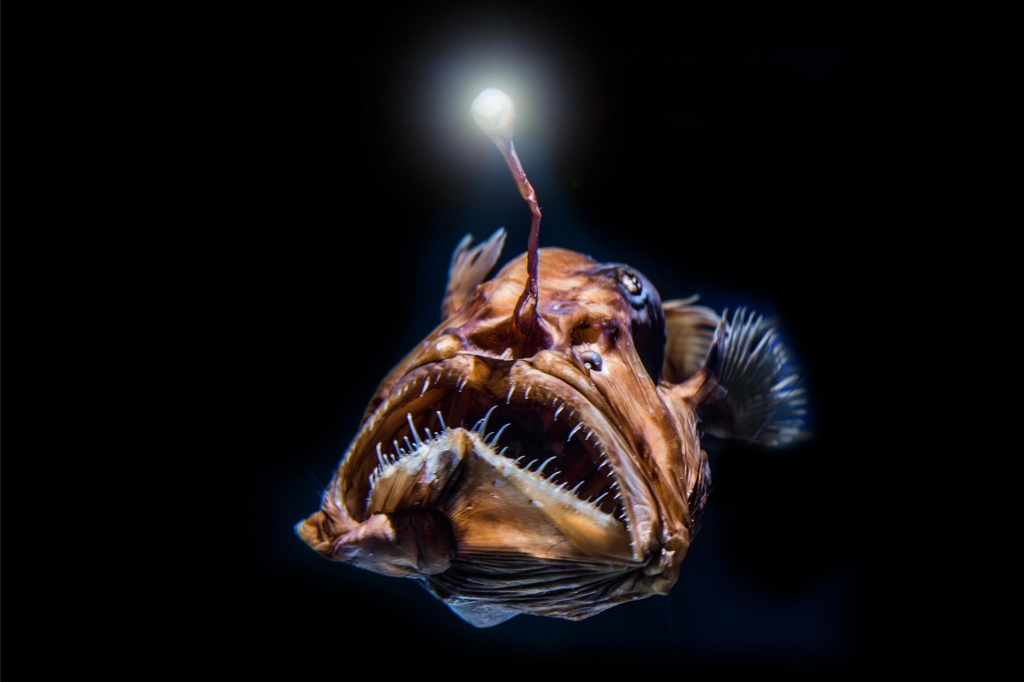
More people have been to space than to the deepest point of the ocean. That fact alone says a lot about how little we actually know about what’s down there — total darkness, near-freezing temperatures, and pressure that would crush a submarine not built to handle it. And yet, life not only survives in that environment, it’s thrived there for millions of years, evolving into some of the strangest creatures on the planet.
Here are ten that sound almost too strange to be real.
1. The Anglerfish
This is probably the most famous deep-sea creature, mostly thanks to its glowing lure — a bioluminescent appendage that dangles in front of its mouth to attract prey in the pitch-black water. What’s less commonly known is how bizarre anglerfish reproduction is: in many species, the much smaller male fuses permanently onto the female’s body, eventually losing his own organs and becoming little more than a built-in sperm supply for life.
2. The Giant Isopod
Picture a woodlouse, then imagine one that grew to over a foot long. Giant isopods live on the ocean floor and are known for surviving incredibly long periods without eating — some specimens in captivity have gone years between meals. Their size is a real-world example of “deep-sea gigantism,” a phenomenon where certain deep-ocean species grow much larger than their shallow-water relatives.
3. The Vampire Squid
Despite the dramatic name, the vampire squid doesn’t drink blood — it actually feeds on marine debris drifting down from above. What makes it strange is its defense mechanism: instead of ink, it releases a cloud of glowing mucus to confuse predators, and it can turn itself almost entirely inside out, wrapping its webbed arms around its body like a cloak.
4. The Fangtooth Fish
Relative to its body size, the fangtooth has the largest teeth of any fish in the ocean — so large that it has special pockets on either side of its brain just to accommodate its jaws when its mouth closes. Despite the terrifying appearance, fangtooth fish are relatively small, usually only a few inches long.
5. The Dumbo Octopus
Named for its two large, ear-like fins that resemble Disney’s flying elephant, the dumbo octopus is one of the deepest-living octopus species known, found several miles below the surface. Unlike most octopuses, it doesn’t have an ink sac — there’s simply no need for it in an environment with almost no light and few visual predators to escape from.
6. The Goblin Shark
With a long, flat snout and jaws that can shoot forward to snatch prey, the goblin shark looks like something built for a horror movie rather than the ocean. It’s rarely seen alive by humans, and most of what’s known about it comes from creatures caught accidentally in deep-water fishing nets.
7. The Barreleye Fish
This one looks almost fake: a barreleye fish has a completely transparent, fluid-filled head, through which you can actually see its tube-shaped eyes pointed upward. The transparent dome protects its eyes while still letting them detect faint light and silhouettes of prey from far above.
8. The Yeti Crab
Discovered relatively recently, in 2005, the yeti crab is covered in pale, hair-like bristles that give it a furry appearance. Those bristles aren’t just for looks — they host bacteria that the crab may use as a food source, a survival strategy suited to areas near deep-sea hydrothermal vents where little else grows.
9. The Giant Squid
For centuries, giant squid were the stuff of sailor legend, and it wasn’t until relatively recently that one was ever filmed alive in its natural habitat. Growing up to 43 feet long, with eyes the size of dinner plates — the largest of any animal on Earth — giant squid are built to detect the faintest traces of light and movement in the deep ocean.
10. The Sea Pig
Sea pigs are a type of sea cucumber that walk along the ocean floor on stubby, tube-like legs, using their translucent, bloated bodies to filter nutrients from sediment. They tend to gather in massive groups, and in some deep-sea footage, hundreds can be seen covering the ocean floor at once, giving the seabed a strange, almost alien texture.
Why This Matters Beyond Just Being Strange
It’s easy to treat deep-sea creatures as pure novelty, but scientists studying them are also learning about extremophile biology — how life survives in conditions once thought impossible to sustain anything at all. Some of what’s being learned from deep-sea organisms is even influencing research into pressure-resistant materials and cold-adapted enzymes used in industries far removed from marine biology.
The Bottom Line
The ocean floor remains one of the least explored places on Earth, and new species are still being discovered in its deepest trenches. Every strange creature on this list is a reminder that even after everything we’ve mapped and photographed on land, some of the planet’s most alien-looking life has been swimming around in the dark the entire time, mostly unnoticed.
If stories like this are the kind of thing you enjoy unwinding with, it’s worth checking out our guide to building a healthier daily routine too — a little curiosity and a little structure tend to go well together.